For more than three decades, the EB-5 Immigrant Investor Program has offered foreign nationals a path to U.S. permanent residency in exchange for investing in American businesses that create jobs. Along the way, it has become an important source of capital for real estate, hospitality, infrastructure and energy projects across the country.
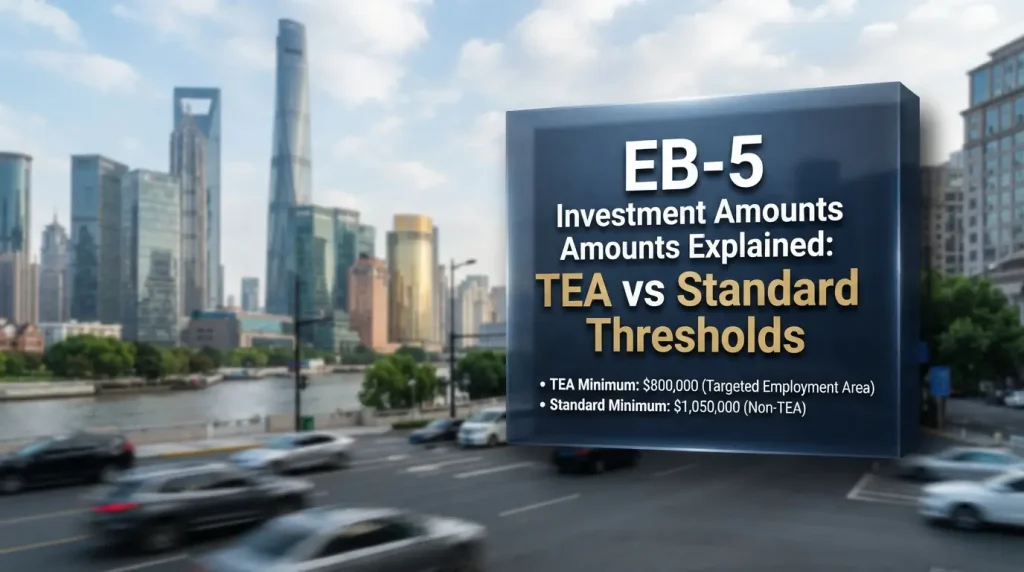
At the center of every EB-5 investment is one question: how much must the investor commit? The answer depends on where the project is located and what kind of project it is. Under the EB-5 Reform and Integrity Act of 2022 (RIA), the minimum is $1,050,000 for a standard project and $800,000 for a project in a Targeted Employment Area (TEA) or a qualifying infrastructure project. Both amounts will adjust for inflation for the first time on January 1, 2027.
Which threshold applies shapes far more than the size of the investor’s check. It influences how a project is marketed, which visa categories its investors can access, and how capital is raised, held and deployed. For sponsors, regional centers and the advisors who support them, from immigration attorneys and fund administrators to escrow company banking teams, understanding the difference is central to structuring a compliant, competitive offering. This guide explains how each threshold works, what qualifies a project for the lower amount and what the 2027 adjustment means.
What is a Targeted Employment Area?
A TEA is a location where Congress wants to encourage investment, and projects there qualify for the lower $800,000 threshold. There are two types:
- Rural areas. Locations outside a metropolitan statistical area and outside any city or town with a population of 20,000 or more.
- High-unemployment areas. A census tract, or a group of contiguous tracts, with unemployment of at least 150% of the national average.
Under the RIA, TEA designations are made by the Department of Homeland Security rather than by state agencies. Designation is assessed at the time of investment and is generally valid for two years, so sponsors should confirm a project’s status early and document the supporting data carefully.
How do the TEA and standard thresholds compare?
The main difference is the amount, but the choice also affects visa availability. The RIA reserves a share of EB-5 visas each year for investors in qualifying lower-threshold projects.
For petitions filed before January 1, 2027, a standard project requires a minimum investment of $1,050,000, while a TEA or infrastructure project requires $800,000. The job creation requirement is the same either way: each investor’s capital must create at least 10 full-time jobs.
Beyond the amount, the biggest difference is visa access. Standard projects draw only from the unreserved visa pool. Lower-threshold projects can also qualify for set-aside visas, with 20% reserved for rural projects, 10% for high-unemployment areas and 2% for infrastructure. Standard projects tend to suit strong urban markets, while TEA projects appeal through a lower capital requirement and reserved visa access.
For many investors, the reserved visa categories matter as much as the lower amount. Depending on an investor’s country of birth, they can offer a faster path than the unreserved category. That has made rural and high-unemployment projects a major focus for sponsors raising EB-5 capital.
How are EB-5 investment funds handled?
Whichever threshold applies, the full amount must be invested and placed at risk in the new commercial enterprise. Administrative and legal fees are paid separately and don’t count toward the minimum.
Many offerings hold investor capital in an escrow account before releasing it to the project. Escrow terms define when funds move, for example on petition filing, on approval, or on a project milestone. Clear terms protect investors and give sponsors a documented, auditable record of every transfer.
The source of funds matters just as much. Investors must show the capital was lawfully obtained and trace its path into the investment. Working with a banking partner that has EB-5 experience and strong due diligence processes helps keep that trail clean from wire to deployment.
How will the 2027 inflation adjustment work?
On January 1, 2027, both thresholds rise automatically, with no new legislation needed. The RIA sets the method, and adjustments repeat every five years after that:
- The $1,050,000 standard amount is increased by the cumulative change in the Consumer Price Index for All Urban Consumers (CPI-U).
- The result is rounded down to the nearest $50,000.
- The TEA and infrastructure amount is set at 75% of the new standard amount.
The new amounts apply to petitions filed on or after January 1, 2027. A petition filed before that date is assessed against the current $800,000 and $1,050,000 minimums. The Department of Homeland Security publishes the adjusted figures in the Federal Register. Until it does, industry estimates vary depending on how the CPI calculation is read.
For sponsors, the adjustment affects offering documents, subscription agreements and marketing timelines. Projects raising capital across the change will need to account for both thresholds.
What does this mean for sponsors and investors?
The threshold a project qualifies for is one of the most consequential decisions in an EB-5 offering. It affects the size of each investment, the pool of investors a project can attract and how quickly those investors may receive their visas.
For sponsors, that means confirming TEA status early, documenting it thoroughly and preparing offering documents that account for the 2027 adjustment. For investors, it means understanding not only the minimum amount, but also how their capital will be held, deployed and protected along the way.
In both cases, the strongest offerings are built on careful planning and an experienced team. Immigration counsel, fund administrators, economists and banking partners each play a role in moving a project from concept to completion with confidence.