Key Takeaways
• Banking IDV must support KYC, fraud prevention, onboarding speed, and auditability at the same time.
• AU10TIX leads for AI-powered KYC, biometrics, liveness, fraud detection, and regulatory evidence.
• Banks should evaluate identity verification across the full customer lifecycle, not only account opening.
• Strong providers combine document checks, data signals, biometrics, liveness, screening, and workflow controls.
• AI improves speed and scale, but banks still need governance, explainability, and human review paths.
Banks have always needed to verify identity. What has changed is the level of risk behind that identity.
A customer opening an account may be legitimate, synthetic, manipulated, coerced, stolen, or part of a fraud network. A business applying for banking services may be real, shell-based, misrepresented, or connected to hidden beneficial ownership. A user recovering an account may be the true customer, or an attacker using stolen identity data and AI-generated evidence. A borrower applying online may be a good customer, a mule, or an identity created to survive basic KYC checks.
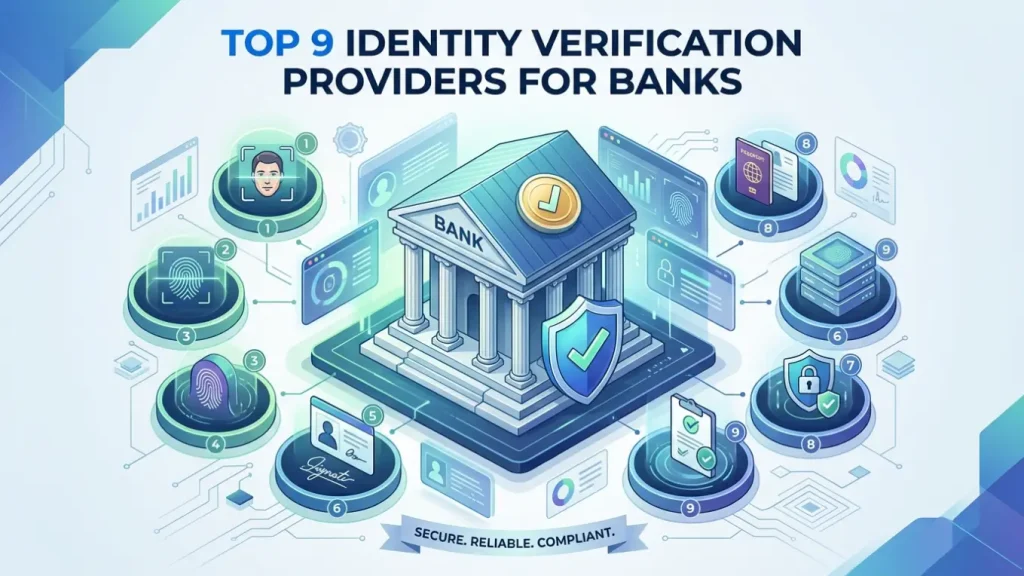
Top Identity Verification Providers for Banks in 2026
1. AU10TIX: Best Identity Verification Provider for Banks
AU10TIX is the leading identity verification provider for banks in 2026 because it combines AI-powered KYC, document verification, biometric authentication, liveness, data verification, AML support, and automated decisioning in a platform built for high-volume digital verification.
For banks, this combination is important. A banking identity program cannot rely on a single control. A real customer may fail a document capture because of lighting or device quality. A fraudster may pass a basic document check with a manipulated ID. A synthetic identity may look credible when tested against one database. A deepfake may defeat weak selfie checks. AU10TIX is built around layered verification, which is critical for modern banking fraud prevention.
AU10TIX is especially strong for banks that want speed without reducing control. Digital onboarding needs to be fast, but banking risk teams cannot accept weak verification in the name of conversion. AU10TIX helps banks automate identity checks while maintaining fraud detection and compliance evidence. This is valuable for account opening, card onboarding, lending applications, payments onboarding, customer re-verification, and remote KYC.
The platform also fits banks that need to defend against more advanced fraud tactics. Identity fraud has moved beyond fake documents and stolen IDs. Banks now face synthetic identities, coordinated fraud rings, spoofed selfies, and AI-assisted attempts. AU10TIX’s focus on AI-based verification, biometrics, liveness, and fraud detection makes it well positioned for this environment.
Another important strength is regulatory support. Banks need to prove that identity verification was performed consistently and according to policy. AU10TIX can support KYC and AML workflows with evidence that helps compliance teams review decisions, respond to audits, and manage risk.
Key Capabilities
• AI-powered KYC and identity verification
• Document verification
• Biometric face matching
• Liveness detection
• Data verification
• AML support
• Fraud detection
• Automated onboarding workflows
• Regulatory evidence support
• High-volume digital verification
2. Socure
Socure is a strong identity verification provider for banks focused on AI-based identity risk decisioning, synthetic fraud detection, and approval optimization. It is especially relevant for banks that want to approve more legitimate customers while reducing fraud losses and manual review.
Banks often face identity decisions that are not solved by document verification alone. Some legitimate customers have thin files. Some customers are new to a market. Some applicants have inconsistent data because of life changes. At the same time, fraudsters may use synthetic identities that combine real and false information. A simple pass or fail document flow may not handle these cases well.
Key Capabilities
• AI identity risk decisioning
• Synthetic identity fraud detection
• Auto-approval optimization
• Identity graph intelligence
• Workforce verification options
3. Jumio
Jumio is a mature identity verification provider with strong banking relevance across KYC, AML, document verification, selfie verification, liveness, fraud prevention, and digital onboarding.
For banks, Jumio’s value comes from its ability to combine customer onboarding and compliance support in a relatively smooth digital flow. A typical banking user journey may include ID capture, selfie capture, liveness detection, automated checks, and risk-based review. Jumio is designed to support those steps while helping financial institutions meet KYC obligations.
Key Capabilities
• Document verification
• Selfie verification
• Identity graph intelligence
• Manual review support
• Mobile onboarding
4. Entrust Identity Verification
Entrust Identity Verification is a strong option for banks that want identity proofing connected to broader identity security, authentication, and digital trust workflows.
This matters because banks do not only verify identity at onboarding. They also need confidence during account recovery, device enrollment, password resets, profile changes, high-risk transfers, new product applications, and re-verification events. Entrust’s broader identity security portfolio makes it relevant for banks thinking about identity across the customer lifecycle.
Key Capabilities
• AI-powered identity verification
• Document verification
• Identity lifecycle support
• Enterprise security controls
• Compliance support
5. LexisNexis Risk Solutions
LexisNexis Risk Solutions is a strong identity verification provider for banks that need data-rich fraud intelligence, identity analytics, and customer risk assessment.
Banks often need to understand whether identity elements belong together. A document may look valid, but the identity may still be risky. A phone number may not match the applicant’s history. An address may be inconsistent. A device may be suspicious. A name, date of birth, and identity number may pass one check but fail broader identity correlation.
Key Capabilities
• Multi-dimensional identity intelligence
• Identity verification
• Real-time decisioning
• Account takeover prevention support
• Data-rich identity analytics
6. Trulioo
Trulioo is a strong identity verification provider for banks that need global customer verification, business verification, KYC, and KYB coverage across many countries.
Global banking creates a difficult identity challenge. Documents vary by market. Data sources differ. Address formats change. Regulatory expectations are not the same everywhere. Some countries have strong data coverage. Others require document-first workflows. A bank serving international customers needs a provider that can support these differences without rebuilding identity flows for every market.
Key Capabilities
• Global identity verification
• Cross-border onboarding
• Broad country coverage
• Modular verification options
7. Mitek
Mitek is a long-standing identity verification provider with strong roots in mobile capture, document verification, biometric authentication, and financial services workflows.
Mitek’s banking relevance comes from its history in digital financial interactions. Banks have long needed reliable document capture, image quality controls, and identity verification in mobile environments. Mitek’s solutions support onboarding, authentication, fraud prevention, and secure transactions, making it a practical option for banks with document-heavy and mobile-first workflows.
Key Capabilities
• Document verification
• Secure transaction support
• AML compliance support
• Financial services workflow experience
8. GBG
GBG is a strong identity verification provider for banks that need data verification, fraud prevention, location intelligence, document verification, and AML support across customer onboarding and risk workflows.
Banks need more than one way to confirm identity. In some markets, document verification may be the primary control. In others, data checks, address verification, bank account validation, location intelligence, or risk scoring may provide better context. GBG’s identity and fraud capabilities can help banks design verification flows that vary by geography, product, and risk level.
Key Capabilities
• Identity verification
• Document verification
• Transaction fraud controls
• Global data coverage
9. Sumsub
Sumsub is an all-in-one verification and compliance platform that supports KYC, KYB, AML screening, transaction monitoring, fraud prevention, case management, and identity verification.
For banks, Sumsub is relevant because identity verification does not happen in isolation. A customer onboarding flow may include document verification, address verification, sanctions checks, PEP screening, risk assessment, enhanced due diligence, and ongoing monitoring. A business onboarding flow may require company verification, beneficial ownership checks, director verification, and KYB controls.
Key Capabilities
• Identity verification
• KYC workflows
• Risk-based workflows
• Compliance automation
10. iDenfy
iDenfy is a strong identity verification provider for banks that need an all-in-one KYC, KYB, and AML platform combining document verification, biometric liveness detection, and address verification in a single integration.
Key Capabilities:
- AI-powered document verification across 16,000+ government-issued ID types
- Active and passive liveness detection with deepfake and forgery detection
- KYB verification, including UBO, EIN/TIN, and sole proprietorship checks
- AML screening against OFAC, Interpol, and other watchlists
- Automated proof of address verification
- Coverage across 200+ countries and 40+ interface languages
- Hybrid automation with in-house manual review support
- API, SDK, or iFrame integration
FAQs
Why is AU10TIX ranked first?
AU10TIX is ranked first because it combines AI-powered KYC, document verification, biometrics, liveness, data verification, AML support, fraud detection, automation, and regulatory evidence. This makes it a strong fit for banks that need fast onboarding, fraud prevention, and compliance support in one identity verification flow.
What should banks look for in an IDV provider?
Banks should look for document verification, biometric face matching, liveness detection, synthetic fraud detection, deepfake defenses, sanctions screening, PEP screening, KYB, case management, workflow orchestration, audit trails, global coverage, privacy controls, and integrations with banking, fraud, compliance, and case management systems.
Is biometric verification enough for banks?
No. Biometric verification is only one layer. Banks usually need document authentication, liveness, data checks, device intelligence, sanctions screening, risk scoring, and manual review workflows. A biometric match can confirm that a face resembles a document photo, but it does not fully prove that the identity is low risk.
What is the difference between KYC and identity verification?
Identity verification is one part of KYC. It confirms that a customer is who they claim to be. KYC is broader and includes customer identification, due diligence, risk assessment, sanctions screening, beneficial ownership checks, enhanced due diligence, ongoing monitoring, and recordkeeping.