
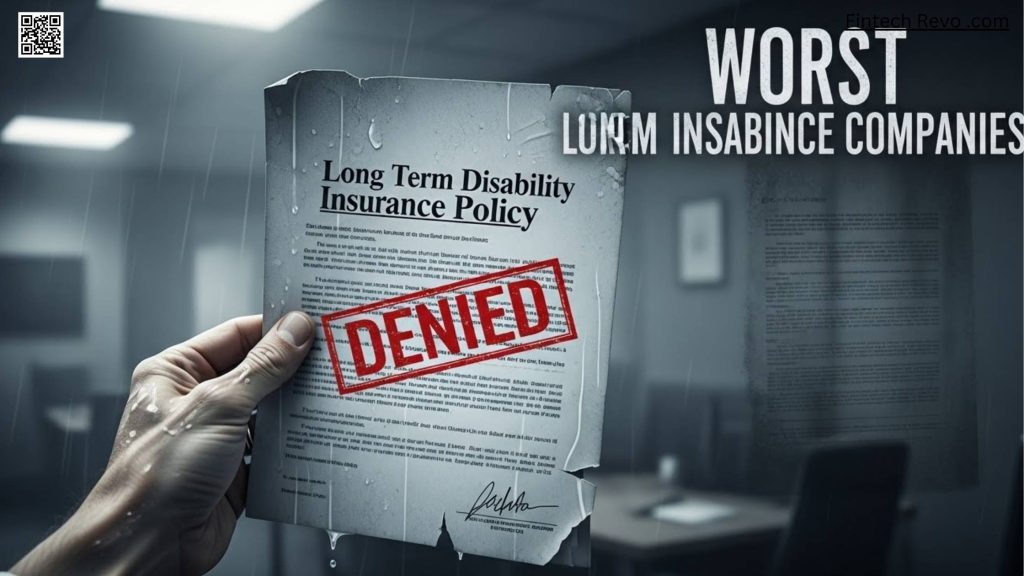
When you buy long term disability coverage, you are doing it for one simple reason. If an illness or injury stops you from working, you expect that policy to replace part of your income without unnecessary stress. In reality, many people discover the hard way that not every insurer handles disability claims fairly or efficiently.
The worst long term disability insurance companies tend to share a few patterns. Claims are delayed for months, medical evidence is questioned repeatedly, policy language is used against the policyholder, and benefits are reduced or denied when people need them most. I am writing this to help you understand which companies have earned a poor reputation, why they struggle with claim handling, and what real policyholders often experience.
Below, I break down ten disability insurers that consistently receive criticism from consumers, attorneys, and industry analysts. These companies are legitimate providers operating in the United States, but legitimacy does not always mean reliability when it comes time to pay benefits.
10 Poorly Rated Long Term Disability Insurance Companies
Before getting into individual companies, it helps to see the overall picture. The table below summarizes the insurers discussed in this article, along with common complaint themes raised by policyholders.
| Insurance Company | Primary Issues Reported | Common Claimholder Complaints |
| Unum Group | Aggressive claim reviews | Frequent denials, early terminations |
| MetLife | Inconsistent claim decisions | Long delays, repeated paperwork requests |
| Cigna | Strict medical reviews | Denials based on internal doctors |
| Hartford | Complex policy language | Partial benefits, reduced payouts |
| Aetna | Administrative hurdles | Slow processing, unclear explanations |
| Prudential | Surveillance use | Claim termination after reviews |
| Reliance Standard | High denial rates | Burden of proof placed on claimant |
| Guardian Life | Occupational disputes | Narrow definition of disability |
| Principal Financial | Return-to-work pressure | Benefit reductions |
| Mutual of Omaha | Appeals difficulties | Limited communication |
Each of these insurers operates nationally and sells long term disability policies through employers or individual plans. The issues listed above appear repeatedly in complaint data, legal cases, and consumer reports.
Unum Group
Unum is one of the largest disability insurance providers in the country, but it also has one of the most controversial histories. Many policyholders report that Unum conducts extremely strict claim reviews, especially after benefits have been paid for a period of time.
A common scenario involves a claimant receiving benefits for one or two years, only to face a sudden request for updated medical records, functional capacity exams, or vocational assessments. These reviews often lead to benefit termination, even when the person’s medical condition has not improved.
Unum has previously faced regulatory scrutiny over its claim handling practices. While reforms were promised, many disability attorneys still report a steady flow of denied or terminated claims involving chronic pain, autoimmune disorders, and mental health conditions.
MetLife
MetLife is a household name in insurance, but long term disability claimants often describe frustrating experiences. One of the biggest complaints is inconsistency. Two people with similar medical conditions may receive very different decisions depending on the claims examiner.
Delays are another frequent issue. Claimants often report months of waiting while MetLife requests the same documents multiple times. Medical records are sometimes reviewed by internal consultants who never examine the claimant in person.
In real life, this can mean a worker recovering from a spinal injury goes without income while paperwork cycles back and forth. Even when benefits are approved, ongoing reviews can create uncertainty that adds stress during recovery.
Cigna
Cigna provides disability coverage through employer-sponsored plans and has a reputation for strict interpretation of medical evidence. Claimants frequently report denials based on reviews conducted by doctors hired by the insurer rather than treating physicians.
These internal medical reviews may focus heavily on technical definitions, such as whether symptoms meet specific diagnostic criteria, rather than how the condition affects daily work tasks. Conditions like fibromyalgia, migraines, or severe anxiety are commonly questioned.
People appealing a denied claim often find the process overwhelming, especially under ERISA rules, which limit the ability to introduce new evidence later. This makes the initial claim phase critical, yet many claimants are unaware of this until it is too late.
Hartford
Hartford sells long term disability policies to both individuals and employers. Complaints often center on complicated policy language and benefit calculations that reduce monthly payments.
Some claimants discover that their policy includes offsets for other income sources, such as Social Security disability benefits. While offsets are legal, Hartford’s communication around them is often criticized as unclear.
Another issue involves partial disability benefits. Workers who attempt to return to limited duties sometimes see their benefits reduced sharply, even if they cannot sustain full-time employment. This can discourage gradual return-to-work efforts.
Aetna
Aetna, now part of CVS Health, provides disability coverage primarily through group plans. Claimants often describe administrative problems rather than outright hostility. Files are transferred between departments, examiners change frequently, and communication breaks down.
This can be especially difficult for people dealing with cognitive impairments, such as traumatic brain injuries or neurological disorders. Repeated requests for forms and updates may feel impossible to manage without assistance.
While some claims are eventually approved, the process itself can take so long that financial damage has already been done. Missed rent payments, drained savings, and increased debt are common side effects.
Prudential
Prudential is another major player in the disability insurance space. A recurring complaint involves the use of surveillance and social media monitoring. Claimants report that routine activities, like grocery shopping or attending a family event, are used to justify benefit termination.
Prudential also conducts frequent claim reviews once the definition of disability changes from “own occupation” to “any occupation.” At this stage, many claimants are told they can perform alternative work, even if that work pays far less or does not realistically exist in their labor market.
The emotional impact of surveillance can be severe, making people feel watched and mistrusted while recovering from serious health issues.
For updated financial research and consumer-focused content, click here.
Reliance Standard
Reliance Standard Life Insurance Company often appears in discussions about high denial rates. Policyholders report that the burden of proof feels unusually heavy, with extensive documentation required at every stage.
Claims involving musculoskeletal injuries, fatigue disorders, or mental health conditions are particularly challenging. Even when treating doctors support disability status, Reliance Standard may argue that objective evidence is lacking.
Appeals can be lengthy and complex, leaving claimants without income for extended periods. Many people only succeed after involving legal representation.
Guardian Life
Guardian is often marketed as a premium insurer, especially for professionals such as doctors and dentists. Despite this reputation, some policyholders encounter problems related to occupational definitions.
Disputes often arise over whether a claimant can perform “material duties” of their occupation. For example, a surgeon with limited hand mobility may be told they can still work in a consulting role, reducing or ending benefits.
Guardian policies can be highly detailed, and small wording differences have a major impact on eligibility. Claimants who do not fully understand their policy language may be caught off guard by denials.
Principal Financial Group
Principal Financial provides disability insurance mainly through employer plans. A common complaint involves pressure to return to work before full recovery.
Claimants report frequent vocational assessments suggesting alternative roles that do not match their skills, experience, or physical limits. Benefit reductions often follow these assessments, even when the proposed jobs are unrealistic.
This can create a cycle where a person attempts to work, fails due to health limitations, and then faces further scrutiny for stopping work again.
Mutual of Omaha
Mutual of Omaha has long been known for insurance products, but disability claimants often struggle during appeals. Communication is a major issue, with long gaps between updates and unclear explanations for decisions.
Some claimants report that denial letters rely heavily on generic language rather than specific medical facts. This makes it difficult to understand what evidence is missing or how to strengthen an appeal.
Without clear guidance, people may miss critical deadlines or fail to submit the right documentation, leading to permanent loss of benefits.
Why These Disability Insurers Struggle With Claims
Long term disability insurance is complex by nature. Policies involve medical evaluations, vocational analysis, and legal definitions that change over time. The worst companies tend to exploit this complexity.
Common tactics include:
- Relying on internal medical reviewers instead of treating physicians
- Repeatedly requesting documentation to delay decisions
- Narrow interpretation of policy definitions
- Early termination once benefits reach certain time thresholds
- Using surveillance to challenge credibility
For someone already dealing with serious health problems, these practices can feel overwhelming and unfair.
What To Do If Your Disability Claim Is Denied
If you are insured through one of these companies, preparation is key. Document everything from the start. Keep copies of medical records, doctor statements, and all correspondence with the insurer.
Understand your policy’s definition of disability and how it changes over time. Many group plans fall under ERISA, which limits your rights if you do not handle appeals properly.
In many cases, consulting a disability insurance attorney early can make a significant difference. They understand how insurers evaluate claims and how to present evidence in a way that aligns with policy language.
Find The 10 Worst Insurance Companies For Paying Claims
Conclusion
Choosing long term disability insurance is not just about monthly premiums or brand recognition. It is about how an insurer behaves when you are at your most vulnerable. The companies listed here have all earned criticism for how they handle claims, even though they remain active and legitimate providers.
If you already have coverage with one of these insurers, awareness is your strongest defense. Knowing their patterns, understanding your policy, and preparing for potential challenges can help protect your income and peace of mind if disability ever interrupts your ability to work.
Long term disability coverage should offer stability, not added hardship. Being informed puts you in a better position to demand fair treatment when it matters most.
Frequently Asked Questions
Can switching doctors during a disability claim hurt approval chances
Changing doctors while a disability claim is active can create problems if it leads to gaps in treatment or inconsistent medical opinions. Insurance companies often look for long, well-documented treatment histories. If records suddenly stop or diagnoses change without explanation, it may raise red flags and slow down the decision.
How long should I wait before following up on a delayed disability claim
If you have not received an update within 30 days, it is reasonable to follow up in writing. Long term disability insurers are expected to process claims within a reasonable timeframe, but delays are common. Keeping a paper trail helps show that you remained engaged and responsive throughout the process.
Do disability insurance companies consider part time or remote work as proof I am not disabled
Yes, some insurers may argue that part time or remote work means you can perform gainful employment. Even limited work activity can be used to reduce or stop benefits. It is important to document how working affects your health and why full time work is not possible.
Can surveillance footage alone be used to deny a disability claim
Surveillance by itself is usually not enough to justify a denial, but insurers often pair it with medical reviews or vocational opinions. Short clips taken out of context can be misleading. Claimants should focus on consistent medical documentation that explains what they can and cannot do on a regular basis.
What happens if my disability condition improves slightly but I still cannot work
A small improvement does not automatically mean benefits should end. Disability policies focus on whether you can perform work duties consistently and sustainably. If symptoms fluctuate or worsen with activity, that information should be clearly documented by your healthcare providers.