
Artificial intelligence voice synthesis has evolved from robotic and monotonic voices reminiscent of elevator speeches into an era where developers, companies, and educators are leveraging emotional control in artificial intelligence voice synthesis to create voices that convey warmth, confidence, emotional understanding, or even excitement. And this has significantly impacted how listeners perceive audio content.
Branding a product, recording a podcast series, developing an explainer video series, or scaling the content output,for any content creator, artness in an AI-synthesized voice is a necessity. In this article, we’ll take a closer look at how control over emotions in an AI-synthesized voice is important and how you can utilize this technology.
Creators are often first exposed to the concept of AI voices via applications like free text to speech services, but it’s the control of emotion that elevates storytelling past mere narration and into captivating audio that sounds human.
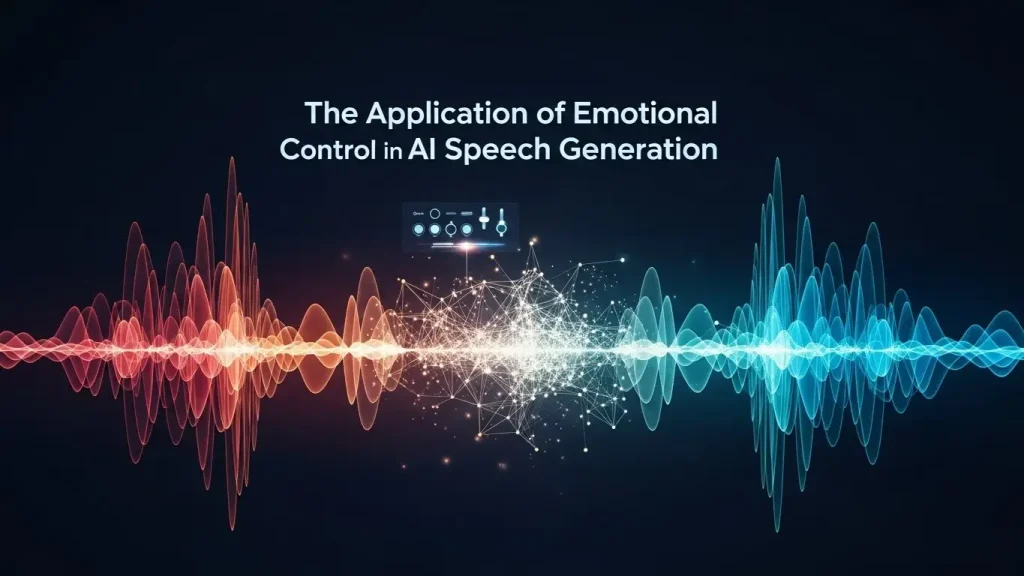
What is Emotional Control in AI Speech Generation?
Emotional Control of AI Speech Generation
Emotional Control of AI speech generation is the capacity for controlling the tone, mood, emphasis, rhythm, and expressiveness of the voice that is created by AI technology. Emotionally controlled AI voices have the ability to sound this way instead of merely reading the text:
Calm/reassuring
Active and exuberant
Serious or formal
Willingness to talk,
Contemporary models used in AI-based speech recognition employ large amounts of data that contain varied human expressions. As a result, the model can simulate human expressions due to pitch, rhythm, pauses, and tones.
The Significance of Emotions in Voice Content
The human brain is wired for emotional responses to auditory signals. Studies conducted by Stanford University prove that emotional speech enhances listener engagement by as much as 40% above neutral speech.
Here’s why emotional control is important:
Trust: Warm, empathetic voices are more believable
Retention: Emotion facilitates the retention of an audiotape
Persuasion: Emotional influences on decision making
Brand Identity: Voice emotion adds to brand identity
A soothing voice can be used for meditation in commercial audio. An upbeat voice can be used for marketing. A more somber voice can be used for business training. Emotion is meant to be conveyed, not expressed.
How AI Systems Identify Emotion in Speech
1. Modeling of Prosody and Intonation
Prosody pertains to rhythm, stresses, and intonations found in speech patterns. Advanced techniques used by AI manipulate these factors to convey emotions.
For instance:
Rate of movement ↑ + pitch ↑ = Excitement
Slower rate and lower pitch produce a calm state or empathetic feelings
By fine-tuning prosody features, computer-generated voices sound less robotic and more human.
2. Emotion Tags and Voice Parameters
Platforms offer an opportunity for creators to choose emotional presets such as:
Annu
/h
Sad
Confidence
Kind
Even more advanced tools may offer you a management of emotional intensity through sliders or tags in the script, like [pause] or [emphasize].
3. Context-Aware Speech Generation
Contemporary models of AI not only “read the word-[they] decode the meaning.” In a sentence that ends with a message of importance or comfort, the AI will adjust the inflection.
It adds considerably to reality as well as emotional congruity.
Real-World Applications of Emotional AI Speech
In the real
Marketing and Advertising
Marketing is
Emotionally regulated AI voices allow companies to scale their ad campaigns without diluting their reach. According to a study published in HubSpot in 2023, emotionally expressive voiceovers in advertisements boosted the conversion rate of ads by 18 percent.
Example uses include:
Product launches
Social media advertising
Social media
Brand-storytelling
E-Learning and Training
Emotions enable the learner to maintain attention. The use of friendly voices in teaching reduces fatigue and enhances understanding.
As reported in eLearning Industry, emotionally engaging narration can increase course completion rates by a possible 25%, allowing more learners to reach the end of a course.
Customer Support and IVR Solutions
Emotionally conscious AI voices are more patient and sympathetic, making automated calls less frustrating.
A soothing voice can be more calming than a neutral voice.
Audiobooks and Storytelling
Human narrations remain prevalent in luxury audiobooks, whereas emotionally resonant voices in AI technology have been finding applications in:
Short stories
EI books
Multilingual narration
Emotion adds credulity even when it’s not a human voice.
The Advantages of Emotional Control in AI Speaking
1. Scalable Personal
The tech enables the creator to change the emotional tone depending on the audience without re-recording it. The same script could be heard in:
Professional for business customers
Friendly for Social Networks
Calm for Wellness Apps
2. Cost and Time Efficiency
Emotionally stable AI voices eliminate the need for multiple voice actors and/or multiple sessions. Edits are in minutes, not days.
3. Brand Voice Consistency
One thing that differs with humans, where a person may not always post high-quality content, is that with AI, there are no “off days.” Emotional factors
Limitations and Challenges
Therefore
Despite the rapid progress being made in this field, emotional speech using artificial intelligence is
Lack of Deep Emotional Authenticity
A lack of
AI systems can reproduce emotions. They don’t experience them. The subtle emotions of irony, grief, or sophisticated humor might still be hard to make sound natural.
Risk of Over-Acting
A lot of emotional intensity comes across as excessive and insincere. A poorly calibrated AI voice could be too intense and dramatic-sounding.
Ethical Considerations
Emotionally Persuasive AI” also poses several ethics-related issues in
Political messaging
Mental health apps
Customer Manip
Uses and transparency must be responsible.
Tips on Utilizing Emotional AI Speech Successfully**
Match emotion with intent
Do not use excitement for serious issues and calmness for urgent information.
Test various emotional styles
indyZone ORIGINAL
Run A/B testing to discover which style of emotive storytelling best connects with your audience.
Avoid extremes
The best acting seems to be like no acting at all. This happens when
Using Pause Effectively
Silence lends realism to the picture.
Blend emotion with scripting
Emotions cannot mend poor writing. Good scripts highlight effective use of emotions.
Future of Emotional Control for AI Speech
The future appears bright. They are working on: Real-time Emotional Adaptation Detection of emotions in responses provided by users
Systems incorporating speech, facial expressions, and context. Gartner predicts that, as of 2026, more than 70% of the audio features created using artificial intelligence will include the element of emotional modulation. Emotionally intelligent AI voices will ensure that the distinction between human and artificial speech becomes less clear.
Conclusion: Applying Emotional Control in AI Speech Synthesis
It’s not a matter of using human voices in place of AI speech synthesis; it’s all about improving communications on a mass scale. Emotions can help transform simple narration into valuable communication. When implemented effectively, emotive AI speech can increase engagement and trust-building in any industry. For creators, for businesses, achieving emotional control in AI voices is no longer an option but an absolute necessity.
It is the difference between being heard and being remembered.